Showing posts with label english countryside. Show all posts

Friday, 8 February 2019

There's pleasure in both

Yesterday, I arrived home after a fortnight away to the first crocus tips emerging from the ground, a garden full of birdsong & sunshine, and the comfort of my own bed. My dear friend had turned on the heating in our cottage a day before I arrived. She had also very kindly put groceries in the fridge and daffodils on the windowsill.

Yesterday, was a day of hot buttered toast, sunlight streaming through the house, and a desperately needed afternoon nap (that dangerously turned into a whole evening and into the night nap thanks to jet-lag).


Today, the wind is gusty and the rain is driven. I've done numerous loads of post-holiday washing and hauled up to the attic the general flotsam and jetsam that accompanies the return from long-haul travel. 

Today, I have run out of almond milk. But there is beauty and simple pleasure in both kinds of days. Sunshine or not. The tapping of rain or the trill of birds. Black tea or milky tea.

It's just so nice to be home.


Kate  x


Thursday, 10 January 2019

The beauty in January

If you live in the Northern Hemisphere, or perhaps anywhere, you might be forgiven for thinking immediately that 'beauty' and 'January' are oxymoronic terms. I am a pretty committed January basher myself. In England, this month is particularly brutal. I saw it described online the other day as a 'miserable f#*king bastard.' Sorry for the language, but you can't argue with its accuracy. 

Then yesterday something slightly magical happened. The morning looked something like this:


The frost glimmered and sun shimmered and all morning long the countryside glistened. 

When January is endless days of enveloping shades of grey, when the air is damp and thick with mizzle, when the sky feels like it is mere inches above your head and you haven't seen the sun in days, it can all get a little too much. But the frosty mornings, cold and crisp as they are, become a joyous antidote to the seasonal glum. 

This year, somehow, January has felt less glum. It might be the uncharacteristically clear blue days, the early appearance of snowdrops, or it might just be my deep commitment to my pj's/hot water bottle/book. 


Long may the frosts bring sparkle to our January.

Happy New Year.


Kate  x


Friday, 22 June 2018

It is a truth universally acknowledged...

...that Jane Austen wrote some of English literature's most beloved novels. 
And last weekend we visited the heavenly village in which most of those novels were written and sent out into the world to be published (and still read, quoted and adored 200 years later).


That village is the picturesque Chawton, where roses ramble up Hampshire-brick cottages and the village cat is called Marmite. He is known to every household as he visits each in turn every morning for his breakfast.


Jane came to live in Chawton, in the South Downs National Park, after her father died. Jane and her sister Cassandra were rendered socially and financially vulnerable upon his death, so moved to the shelter of a cottage (below) on the Chawton House Estate, owned by their wealthy brother, Edward. That cottage is now The Jane Austen House Museum, visited by hundreds of thousands of people each year. The cottage is beautiful and has some of the most profoundly important objects relating to the life and legacy of Jane Austen on display, not least the very writing table on which she wrote and reworked most of her published works. It is quite the experience.


The Chawton Estate is beautiful. An Elizabethan Mansion, surrounded by the most verdant green countryside you could possible imagine. It is the quintessential English idyll. 


Inside, Jane is of course celebrated, but so are other female novelists. This year, as it is the 200th anniversary of Northanger Abbey, the gothic novel is the main focus. Chawton House is home to some of the most precious first edition and rare books in England, kept in a locked and climate controlled library, it is an exciting room to get a peek at. 


The Jane Austen rose growing in the walled garden at Chawton House.

Below is the parish church, situated on the estate, it is the burial place of Jane's mother and sister. Jane herself is buried in nearby Winchester Cathedral. Jane travelled to Winchester at the end of her life to be near a doctor due to her failing health. She never returned to Chawton, dying a short time later just a couple of doors away from the cathedral.  


The bronze of Jane at the top of this post was commissioned to commemorate the 200th anniversary of her death. It was displayed next to her grave in Winchester Cathedral. The original 1817 plaque erected at her grave gave no mention of her novels, and her funeral was attended by only four people. Later, a second plaque was inscribed more fittingly,

'Jane Austen, known to many by her writings..'

The most beautiful thing about Chawton, and indeed The Jane Austen House Museum, is that although it is a year-round tourist destination and a sort of Mecca for Austenites the world over, it does not feel at all touristy, gimmicky or commercialised. It so sympathetically and gently celebrates Jane's contribution to English literature and indeed popular culture. We arrived, entirely by coincidence, at the start of regency week, and even then the village was relatively quiet and devoid of unseemly commercialisation. Perhaps illustrating my point best is that the tickets you purchase to visit her cottage and her brother's estate are valid for a whole year. I can't think of anywhere else I have visited in England that is less mercenary than that!


And we, having had a small chunk of our hearts stolen by Hampshire and Chawton in particular, will certainly be back to take advantage of such a benevolent gesture.


Kate  x


Monday, 28 May 2018

The month of May

In the British countryside, the month of May is best summed up as abundant.
The verges and laneways are cloaked with dandelions that reach for the sky and lacy cow parsley that grows at a rate of knots. The hedgerows are filled with blossom, bluebells and a dozen more things I still can't name. Woodland undergrowth is a sea of wild garlic flowers and wild anemones. Agricultural crops are inching up, higher and higher each day. The perimeters of the fields are dotted with clouds of hawthorn in mid-blossom. 

After months of dormancy, everything unfurls, climbs and blooms all at once. 


After a long, bleak winter, you easily forget that England could be this green and fertile! 
The sun has drenched the West Country all month long, sending crops and weeds alike hurtling ever skyward. The daylight and the birds softly begin around 4am, our thin linen drapes no match for their early morning enthusiasm. I really don't mind though. I relish the languid nature of this time of the year as British summertime stretches the days to their pinnacle; 17+ hours long. Going for post-supper walks in the warmth of the sinking sun is such a treat. 


I regularly pull on my wellies and squelch up my favourite local bridleway before wandering along a long forgotten cobbled Roman road running alongside lush, sheep dotted farmland. The Fosseway is close by and Roman history is well documented in this rural pocket at the junction of Wiltshire, South Gloucestershire and North Somerset. My route takes me across a Roman footbridge, though I usually eschew it for the opportunity to wade through the crystal clear water of the brook, giving my wellington boots a much-needed wash in the process. I walk home through the village, peering over garden gates to see what will be in flower next.


As May draws to a close, I see roses blooming around cottage windows, foxgloves outstripping dandelions and hot-pink valerian sprouting from the crevices in stone walls. 
Which means only one thing, 
summer is nigh.

Kate  x

Monday, 7 May 2018

Country pursuits

The warm weather has graced us at long last! Summer may have actually leap frogged spring and arrived early this year. Not that anyone minds. The whole country seems collectively drunk on sunshine and long languid days outdoors sipping Pimms.

We feel especially lucky to have been gifted a bank holiday weekend filled to the brim with uninterrupted sun and temperatures above 23 degrees C! The English summer is punctuated by showers and wholly unfair temperature dips even at the best of times, so this weather is throughly welcome and embraced (pink nose and shoulders attest to that). 


We've been outside almost non-stop. Tea drinking in the garden, Pimms at the village pub, and post-supper walks in the woodland; which are carpeted in frothy wild garlic flowers and that very particular blue hue that belongs entirely to English bluebells. 

It feels like heaven on Earth.


We attended the last day of Badminton Horse Trials yesterday where I was overcome with a sudden urge to curate the perfect country lady wardrobe consisting of all things tweed, forthwith adorning every outfit with pheasant & mallard feathered brooches. The deeper I get into life in rural England the less ridiculous I feel about owning a felt fedora or a third pair of wellington boots.
I have found my bliss in the English countryside, and now I need the wardrobe to match! Or perhaps it's the sunstroke fuelling a sartorial quarter-life crisis. 


However you're enjoying these long and light filled days on the cusp of true British summertime, have a Pimms for me.


Kate  x


Wednesday, 11 April 2018

April showers

If April showers do indeed bring May flowers, the west country should resemble a flower farm come next month. So far April has been a soggy wash out, which feels doubly unfair seeing as March was punctuated by unseasonably cold temperatures and multiple snowfalls.


Despite a slow start, my garden is finally blooming with life. The daffodils and narcissus are opening their cheery smiling faces. An overgrown forsythia has burst with bright sunshine yellow blossom. The flowering currant is heavy with flowers as well as raindrops. And my tulips are not far behind.


But the mud!!! The mud is never ending. Oh, what i'd give for a lovely boot room to contain wet coats and muddy wellies in...

Even a porch would suffice. Unfortunately for my floors, we step straight from outdoors into the kitchen in our home. With no where dry or covered to remove shoes and coats other than the kitchen, it has been quite a long winter trying to keep the floors clean. I shouldn't moan. I wouldn't swap countryside living for (almost) anything. I adore being able to pull on wellies and seconds later be stomping through the woodland or splashing up the lane to get eggs at the farm gate. 

Mud is simply a close companion to country life. 
I know this very well. 
Now. 

But the first time after we moved here and my new friend asked if I wanted to go for a walk, I stupidly pulled on my active wear and laced up my trainers. I really did think she would be similarly attired. Moments before she arrived at my front door I came to my senses and changed into jeans & wellies. Context is everything. I wasn't going for walks around the leafy suburban streets of the lower north shore in Sydney anymore. No! The paths I now walked were made entirely of mud. A couple of minutes later she knocked on my front door wearing Le Cheameau's and I knew I'd come very close to looking like a clueless townie playing at country pursuits.

Jeans + wool jumper + wellies. 
That's my uniform now. Such is living in the English countryside.

Kate  x

Saturday, 17 February 2018

Muddy wellies and lent lilies

My wellies might be the muddiest they've been since first treading on English soil, 
but yesterday I spotted daffodils in the dappled light of School Lane.


The European wild daffodil is also called the lent lily as it blooms concurrently with the lenten season. The smiling yellow faces of daffodils are such a welcome sight each year. Here in our village they cling to the damp banks of the brook, tall and proud, gazing at their reflection in the swirling water below them. I remember when we first moved here I really appreciated the great number of daffodils planted throughout this corner of Wiltshire. In just about every village we drove through, dense clumps of daffodils greeted us along the roadsides. To have the bright canary yellow colour spreading their cheer after a winter devoid of colour was such a joy to see. 

Spring is starting to creep in, tinging the air with warmth and sunshine, unhurried, but growing in strength with each passing week. Even the chickens agree.


More and more often my wanders up the lane to the farm gate are rewarded with fresh speckled eggs. Never uniform, but always eliciting a smile from me.


Kate  x


Tuesday, 13 February 2018

Yew trees and snowdrops


Painswick had been on my 'to visit' list for well over a year. I'd been patiently waiting for snowdrop season to come around again before making the trip up into Cotswold heartland. Painswick is a handsome village, beautifully situated in the verdant Cotswold Hills, with renowned walking routes on the doorstep and stunning countryside views. She is the undisputed 'Queen of the Cotswolds'. 


Our main focus on this trip was seeing the famous snowdrop display at Painswick Rococo Garden. An impressive carpet comprised of millions & millions of tiny white blooms cascaded down slopes and spread through the wooded undergrowth of the garden. But unexpectedly, it was the yew trees in the churchyard of St Mary's that emerged as the highlight of our visit.


For a long time, 99 yew trees grew in this churchyard, and according to legend if a hundredth tree was to be planted the devil would destroy it. At the turn of the new millennium every parish in the diocese of Gloucester was presented with a yew tree to plant to mark the occasion. Parish officials faced a dilemma... 
Painswick was chosen to host the blessing of these trees as they were handed out to the various parishes. The 100th tree was planted at the start of the new millennium and, contrary to the often cited legend, is growing well. 

The trees are clipped every September, producing in excess of 2 tonnes of yew clippings. These clippings are actually used in the manufacture of an anti-cancer drug, specialist contractors are employed to process the clippings.


I look forward to a return visit one day, hopefully in late spring when the Cotswold Way is lush and overgrown with wildflowers and the day light stretches late into the evening. 

Kate  x


Friday, 9 February 2018

A secret garden

A garden unfurls its secrets month by month, 
as the seasons blossom, then ebb away.


“And the secret garden bloomed and bloomed 
and every morning revealed new miracles.” 
 Frances Hodgson Burnett


February is the last unknown month in our little patch of earth- a courtyard garden enclosed by a Cotswold stone wall, nestled deep within the By Brook Valley, and overlooked by soaring beech trees. From March, we'll start to cycle through the seasons again, this time with a year of knowledge behind us.

So, what has appeared this month?


Hundreds and hundreds of snowdrops. 

Defying the freezing nights and harsh frosts, they began to emerge before the new year had even begun. Now, with a touch of weak winter sun on their pure white faces, they sit gently nodding in unison in the frigid breeze. All around them signs of spring are following suit- the tips of bluebells, daffodils, narcissus and tulips are likewise pushing up through frozen ground and decaying leaf litter to greet the sunshine. A few aconites have popped their canary-yellow heads up amongst the bare branches of a fuchsia bush. Buds are appearing on the rose bushes and the snowball viburnum. Leaves are tentatively unfurling, slowly, but they're definitely there.


Next month I know the garden and the countryside will become a riot of bright yellows. Daffodils, forsythia, primrose and gorse will take centre stage, and the agricultural land around us will be awash with sunshine-yellow rapeseed. For now though, the snowdrops sit in their thousands, bobbing in the breeze.


Kate  x


Saturday, 23 December 2017

An English Christmas

For many people, Christmas begins on Christmas Eve when a single clear-voiced treble from the Choir of King’s College, Cambridge, sings the first verse of “Once in Royal David’s City”, a heart-wrenching moment, audible via the BBC World Service to a potential listenership of 40 million.


Our own Christmas Carol service in the village church, St Andrew's in the Parish of Castle Combe, began in very much the same way. It is a stirring and beautiful tradition, sung for us by a sublime soprano voice standing at the west door of the church. By the time the rest of the congregation had finished the second verse in unison, the church was filled with visible breath and a familiar warm & merry energy that belongs exclusively to Christmas gatherings.  

Our 6pm Carol service began without a vicar. He'd been told that the service began at 7pm. When he did arrive, at around 6.10pm, he emphasised how early he was. Taking over the service part way in, it took him a moment to find his place.

Vicar: Have you had the Bidding Prayer?
Congregation: Yes!
Vicar: Good, I don't need to do that. Have you blessed the crib?
Congregation: Yes!
Vicar: Very good. I can tick that off. Right, 
then you can all sing Hark! The Herald Angels Sing!

At one point he was heard in the aisle asking himself, "Okay, what happens now?" Before remembering to light the Advent Crown.

We were sat in a pew next to the organist's wife who we briefly chatted to after the service. After asking us if we lived in the village she told us she lived nearby and was there because she's married to the organist; who the parish had found on lastminutemusicians.com two days prior to the carol service! Apart from it being an amusing story, it was another little jolt of festive spirit.

However you spend Christmas,
have a very merry one!


Kate  x


Tuesday, 28 November 2017

The Derbyshire Dales

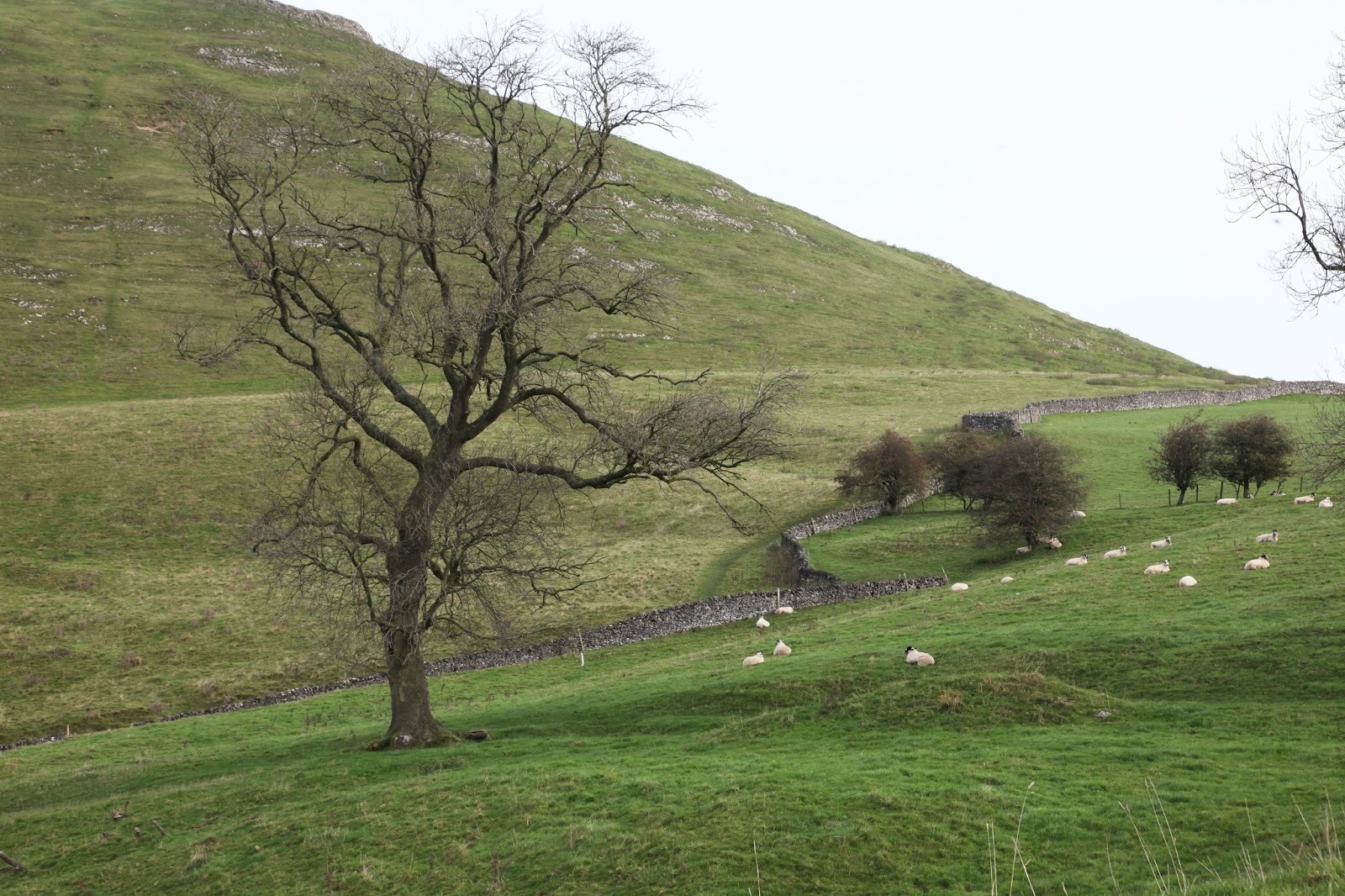
The Derbyshire Dales are pretty indeed, but not in a way that is wholly unbelievable like some of England's southern areas of reputed natural beauty. Derbyshire is real.

The rolling emerald green hills, intersected with miles upon miles of grey stone walls, are dotted with very attractive stone barns and outbuildings, their pleasing aesthetic a happy accident of their utilitarian use and design. The barns, and the machinery they house, are very much for function. And on the horizon you will see the silhouette of chimney stacks, their trailing smoke plumes indicative of a long industrial history. The North is the birthplace of industry. From the peak of the industrial revolution in the 19th Century to the manufacturing heydays of the 20th, the timeline of modern industry is woven through England's North.

The natural landscape is wild and weather beaten in places. But its rugged and exposed beauty is no to obstacle to the people who live and farm here.


Kate  x