Tuesday, 28 August 2018

Jordan, Part 1: Machaerus and Umm Al Rasas

I arrived at the hotel in Madaba by taxi at around 1.30am. I was awoken by the "dawn" call to prayer at 4.30am. This set the tone for my week in Jordan- very little sleep, running on equal parts pure adrenalin and a thirst to just see and do everything because I couldn't quite believe I was there and what I was seeing.


Before I begin though, i'll just explain how I came to be on holiday in Jordan. A few months ago my "mother in law" (Alex's Mum) called to say she was planning on going on a trip to Jordan with some friends (they all currently live and work in neighbouring Saudi Arabia), and asked if we would like to go along on the trip too. Alex was busy with work, but encouraged me to go. So, before he'd really even given me a moment to think about it, he was booking my flights. I had always wanted to see Petra and swim in the Dead Sea to experience the closest thing to weightlessness you can get on Earth... and it was easy to say yes knowing that I would be traveling with a group of people very familiar with the Middle East. I could not have been in better hands or had a more positive experience. The friends who had orchestrated the trip have travelled extensively in Jordan several times, and they went above and beyond to show us everything- the well documented tourist sites, and the sites that are so often overlooked. They were enthusiastic from start to finish and looked after us as though we were paying them to be our private travel guides, but they were doing it out of friendship and a deep love for Jordan and a desire to share it with us. I honestly can't thank them enough.

After that first very early morning wake up call, the rest of the party arrived at the hotel by mid-morning, we fuelled up on one-dinar chicken shawarmas and hit the road (in the largest Chevrolet that Amman airport could provide us). The first site we visited was Machaerus, or Herod's Castle, the ruins of a fortified palace built on top of a high mountain overlooking the Dead Sea. 


Needless to say the climb up was hot and dusty. Machaerus is remote and exposed, there is no shade and very little obvious human activity in the surrounding countryside, a few lone shepherds on the roadsides and a sprinkling of homes, but no real sizeable towns or villages nearby. 


Photographs will never properly communicate the vastness or the stark beauty of Jordan. These valleys are immense and provide breathtaking views. To convey a little of the scale, that is a house on the hilltop on the right most hill. Below is the Dead Sea and in the hazy distance is Israel.


Again, in an attempt to show scale, that tiny black spec on the middle hilltop is a group of people. I am pretty sure my camera lens was zoomed in as far as it could go too. 

At around 1,100m above Dead Sea level, it was an impressive and strategic fortress. Built in approximately 90 BC by Alexander Jannaeus, the fortress provided a clear view of invading armies from the East and from its high position could easily signal other citadels of impending danger. It was destroyed in 57 BC by one of Pompey the Great's generals, and rebuilt by Herod the Great in 30 BC as a military base. The Romano-Jewish scholar, Flavius Josephus, cites Machaerus as the imprisonment and execution place of John the Baptist. Today, all that remains are the foundation stones and two pillars, though under the current ground level the unexcavated remains are extensive.


One of the most fascinating things about this area was spotting the many caves in the hillsides that are home to the Bedouin. I couldn't imagine a more inhospitable landscape, and yet the valleys were full of cave systems with neat door shaped stonework at the mouth of the caves.


One of the absolute standout historical sites for me was Umm Al Rasas, a series of ancient church ruins containing remains from the Roman, Byzantine and early-Muslim periods. Largely unexcavated, the area began as a 5th Century Roman military camp. What is special about Al Rasas though, is the high concentration of churches- 19 churches according to our guide- in a very small area. The detailed mosaic floors of these churches are breathtaking. 


We enlisted an archeology student working in the tourist office at the entrance to be our guide, and this was one of our best decisions, his knowledge and enthusiasm for the site was wonderful. Though he stated it was up to us whether we should tip him or not, we were more than happy to do so, he really enriched our visit. 

[At many tourist sites in Jordan you will encounter people eager to play "guide"- this can be a good or a slightly annoying thing depending on their motivations and actual knowledge (or lack there of). In some places we were happy to be shown around, in others we just wanted to wander and absorb at our own pace. Don't be afraid to state clearly that you do not want a guide if you find them to be overly pestering, and have a handful of dinars on you to tip at the end if you do choose to be shown around. At the larger sites where the guide might stay with you for a couple of hours (such as Jerash and Petra) make sure you agree to a price at the start before you set off. Beware of anyone thrusting a "gift" into your hands. They will ask for money by the time they are done showering you with presents. That lesson cost me three dinar, and some slight annoyance at having to carry around things that I never wanted and tried to refuse in the first place. Likewise, if you visit a remote site that isn't overseen in any real official capacity, and is manned by a neighbouring farmer or shepherd, or a kindly local, do tip them. Five or so dinar was our general rule.]


These are the remains of the earlier Roman settlement. It is quite extraordinary that many of the arches and walls are still standing, some 2500 years after they were constructed, having also withstood two major earthquakes that rocked much of the Arabian region. The remains extend below ground, perhaps by another 2 storeys, but in order to excavate the site properly, the top storey would be ruined, and so it is preserved as best it can be as it currently stands. 

The most important and protected of the mosaics is the floor of Saint Stevens Church, dated from 785 AD, and the floor of the Church of Bishop Sergius from 587 AD. These mosaics are incredibly detailed and feature many of the important cities of ancient Arabia, as well as intricate hunting and fishing scenes. The lettering is Ancient Greek.


Constructed of tiny and precise, hand-cut, naturally coloured stones, these mosaics are utterly mind blowing. Very kindly, our guide took us to a covered over mosaic (many of the church floors are covered up with sheets weighed down by sand to protect them from the elements and animals), to demonstrate the true beauty of these works of art.


He swept back the sand to reveal the floor of the Church of the Lions, named quite simply due to the two mosaic lions, and poured water over their faces.

We all exclaimed in awe!


And then a shepherd came through the site with his flock of sheep and goats, 
so very Jordan.


As I go back through my photographs and collate them, I realise that my Jordan trip may need to be recorded over several posts. So, i'll conclude this initial post by sharing a few helpful hints. 

The Jordan Pass that acts as your visa when you visit Jordan is invaluable. I purchased the Jordan Wanderer for 70 Jordanian dinar and added the Baptismal site for an extra 8 dinar or so. This pass gets you in almost everywhere, and will save you lots of money if you plan on visiting Petra and Jerash. Buy it before flying into Amman to save on time and visa fees at the border. 

You will need to buy lots of water. I took a refillable metal water bottle, but couldn't use it as the tap water is not safe to drink. Most places sell water, but be aware of what you are buying. Make sure the bottles are new, fresh and safely sealed. I am pretty sure I bought a dodgy (old and refilled) bottle inside of Petra, and I was quite unwell afterwards. 

Lastly, Jordan is an incredibly welcoming country. It is very poor and many things about it can be a little confronting (the litter, the tent homes on remote roadsides, and the condition that some of the animals are kept in), but the Jordanian people are some of the most hospitable people on earth. They won't hesitate to invite you into their homes for tea, or assist you when your vehicle gets stuck down a particularly acute drop off the side of the road. 

Typical remote tent(s) of shepherding family.


Kate


I will cover the likes of Jerash, Petra, and the Dead Sea in further posts.


Sunday, 15 July 2018

Summer reading

My intentions are always to read more books. Just recently I was musing out loud to Alex that there must be a word in the English language for that slightly anxious feeling you get deep down in your stomach when you think of all the beautiful books that exist in the world that you will never have enough lifetime to read...


To which he replied something along the lines of, "You big nerd."

With all of that in mind, here's what I have recently read, am currently reading, and what I'd like to read in the coming months.

I began the summer with The Guernsey Literary & Potato Peel Pie Society, and it might just be my favourite book so far this year. It's sweet, and delicate, and warm, and just so beautifully constructed. I finished it and immediately went to see the film which was just as lovely. I now have a burning desire to holiday in the Channel Islands and an unquenchable crush on Michiel Huisman who plays Dawsey in the film adaptation (He is similarly gorgeous in The Age of Adaline and Irreplaceable You).

With good intentions to do a balmy evening walk in the Slad Valley this summer, I picked up Laurie Lee's classic homage to The Cotswolds, Cider with Rosie, but I must admit I have struggled to get really into it. It is lovely and nostalgic, with many funny anecdotes, but I am yet to finish it. I'll get there, it is an English classic afterall.

Like almost everyone else this summer, I gobbled up Dolly Alderton's, Everything I Know About Love (not pictured), in roughly 48 hours. It's an easy and very digestible read, and although she's the exact same age as me, we spent our twenties in very different ways! Dolly is funny and articulate, very vivacious in places, but with her own obvious insecurities. It's difficult not to like her and get something out of her memoir. I am looking forward to seeing Dolly talk at Calcot Manor later this month.


Having been incredibly touched by Me Before You by JoJo Moyes a few years ago, I bought the sequel, After You,  recently in a Bath charity shop. It took me a while to get fully absorbed in this book- I really wasn't expecting the plot to be what it is- but once I was perhaps a third of the way through I couldn't put it down. It's not moving in the same ways as the first novel, but it is rather enjoyable in a fluffy literature sort of way nevertheless.

Farm From Home is incredibly visually appealing and I bought it because it celebrates the English countryside through each month of the year, seasonal living being something I am very taken by. Amanda Brooks takes lovely photographs, though I didn't think it was the most amazingly well written book. It is very much a memoir in the form of a coffee table book, (yes, I read a lot of memoirs) recounting her move from being a high flying New York fashion figure to life on her husband's family farm in Oxfordshire. Many people have highlighted that Farm From Home is a celebration of a life that is highly unattainable for most people, and it is, but there's earnestness in the pages too. 

The Worry Trick is a rather practical guide to recognising how chronic worry can become part of some people's lives. I don't make a habit of reading "self help", but it is pretty insightful. Useful if you, like me, wonder where the line between acute worry and anxiety is exactly. 

And The Worry Trick may come in super handy because last night I started reading Joan Didion's gut-wrenching memoir, The Year of Magical Thinking, which contains one of my greatest fears- the unexpected loss of a spouse or loved one. For those unfamiliar with this very raw memoir, The Year of Magical Thinking details a particularly brutal chapter in Joan's life. A few days before Christmas 2003, Joan and her husband John witnessed their daughter fall seriously ill, being placed in an induced coma and put on life support. Just before New Year's Eve, whilst their daughter was still hospitalised, John died very unexpectedly. I had a knot in my stomach before i'd even finished the second page. It is such a devastating read, but is so exquisitely well written. 


With summer only halfway done, my summer reading list is still very much under construction. I am keen to get my hands on a copy of The Making of a Marchioness by Frances Hodgson Burnett because I adore her children's fiction. And as I am visiting Jordan next month, I hope to read Her Majesty Queen Noor's memoir, A Leap of Faith: Memoir of an Unexpected Life. 


Other short and lovely things I've read include:

Bill Nighy's list of things that bring him delight, HERE

This poem, below.


And this quote of unknown origin that sums up my existence with searing accuracy:

"Getting emotional over fictional couples 
is not how I envisioned my adult life."


What are you reading and loving?


Kate  x


Friday, 22 June 2018

It is a truth universally acknowledged...

...that Jane Austen wrote some of English literature's most beloved novels. 
And last weekend we visited the heavenly village in which most of those novels were written and sent out into the world to be published (and still read, quoted and adored 200 years later).


That village is the picturesque Chawton, where roses ramble up Hampshire-brick cottages and the village cat is called Marmite. He is known to every household as he visits each in turn every morning for his breakfast.


Jane came to live in Chawton, in the South Downs National Park, after her father died. Jane and her sister Cassandra were rendered socially and financially vulnerable upon his death, so moved to the shelter of a cottage (below) on the Chawton House Estate, owned by their wealthy brother, Edward. That cottage is now The Jane Austen House Museum, visited by hundreds of thousands of people each year. The cottage is beautiful and has some of the most profoundly important objects relating to the life and legacy of Jane Austen on display, not least the very writing table on which she wrote and reworked most of her published works. It is quite the experience.


The Chawton Estate is beautiful. An Elizabethan Mansion, surrounded by the most verdant green countryside you could possible imagine. It is the quintessential English idyll. 


Inside, Jane is of course celebrated, but so are other female novelists. This year, as it is the 200th anniversary of Northanger Abbey, the gothic novel is the main focus. Chawton House is home to some of the most precious first edition and rare books in England, kept in a locked and climate controlled library, it is an exciting room to get a peek at. 

The Jane Austen rose growing in the walled garden at Chawton House.

Below is the parish church, situated on the estate, it is the burial place of Jane's mother and sister. Jane herself is buried in nearby Winchester Cathedral. Jane travelled to Winchester at the end of her life to be near a doctor due to her failing health. She never returned to Chawton, dying a short time later just a couple of doors away from the cathedral.  


The bronze of Jane at the top of this post was commissioned to commemorate the 200th anniversary of her death. It was displayed next to her grave in Winchester Cathedral. The original 1817 plaque erected at her grave gave no mention of her novels, and her funeral was attended by only four people. Later, a second plaque was inscribed more fittingly,

'Jane Austen, known to many by her writings..'

The most beautiful thing about Chawton, and indeed The Jane Austen House Museum, is that although it is a year-round tourist destination and a sort of Mecca for Austenites the world over, it does not feel at all touristy, gimmicky or commercialised. It so sympathetically and gently celebrates Jane's contribution to English literature and indeed popular culture. We arrived, entirely by coincidence, at the start of regency week, and even then the village was relatively quiet and devoid of unseemly commercialisation. Perhaps illustrating my point best is that the tickets you purchase to visit her cottage and her brother's estate are valid for a whole year. I can't think of anywhere else I have visited in England that is less mercenary than that!


And we, having had a small chunk of our hearts stolen by Hampshire and Chawton in particular, will certainly be back to take advantage of such a benevolent gesture.


Kate  x


Saturday, 9 June 2018

The roses are here


I have been watching hopefully,
 and counting buds eagerly,
 and excitedly anticipating
 the roses blooming in my garden this year.

And now they are here!

These are the first snippings for this season. It is a DA rose named The Ancient Mariner. 

And it smells as exquisite as it looks.


Kate  x

Monday, 28 May 2018

The month of May

In the British countryside, the month of May is best summed up as abundant.
The verges and laneways are cloaked with dandelions that reach for the sky and lacy cow parsley that grows at a rate of knots. The hedgerows are filled with blossom, bluebells and a dozen more things I still can't name. Woodland undergrowth is a sea of wild garlic flowers and wild anemones. Agricultural crops are inching up, higher and higher each day. The perimeters of the fields are dotted with clouds of hawthorn in mid-blossom. 

After months of dormancy, everything unfurls, climbs and blooms all at once. 


After a long, bleak winter, you easily forget that England could be this green and fertile! 
The sun has drenched the West Country all month long, sending crops and weeds alike hurtling ever skyward. The daylight and the birds softly begin around 4am, our thin linen drapes no match for their early morning enthusiasm. I really don't mind though. I relish the languid nature of this time of the year as British summertime stretches the days to their pinnacle; 17+ hours long. Going for post-supper walks in the warmth of the sinking sun is such a treat. 


I regularly pull on my wellies and squelch up my favourite local bridleway before wandering along a long forgotten cobbled Roman road running alongside lush, sheep dotted farmland. The Fosseway is close by and Roman history is well documented in this rural pocket at the junction of Wiltshire, South Gloucestershire and North Somerset. My route takes me across a Roman footbridge, though I usually eschew it for the opportunity to wade through the crystal clear water of the brook, giving my wellington boots a much-needed wash in the process. I walk home through the village, peering over garden gates to see what will be in flower next.


As May draws to a close, I see roses blooming around cottage windows, foxgloves outstripping dandelions and hot-pink valerian sprouting from the crevices in stone walls. 
Which means only one thing, 
summer is nigh.

Kate  x

Monday, 7 May 2018

Country pursuits

The warm weather has graced us at long last! Summer may have actually leap frogged spring and arrived early this year. Not that anyone minds. The whole country seems collectively drunk on sunshine and long languid days outdoors sipping Pimms.

We feel especially lucky to have been gifted a bank holiday weekend filled to the brim with uninterrupted sun and temperatures above 23 degrees C! The English summer is punctuated by showers and wholly unfair temperature dips even at the best of times, so this weather is throughly welcome and embraced (pink nose and shoulders attest to that). 


We've been outside almost non-stop. Tea drinking in the garden, Pimms at the village pub, and post-supper walks in the woodland; which are carpeted in frothy wild garlic flowers and that very particular blue hue that belongs entirely to English bluebells. 

It feels like heaven on Earth.


We attended the last day of Badminton Horse Trials yesterday where I was overcome with a sudden urge to curate the perfect country lady wardrobe consisting of all things tweed, forthwith adorning every outfit with pheasant & mallard feathered brooches. The deeper I get into life in rural England the less ridiculous I feel about owning a felt fedora or a third pair of wellington boots.
I have found my bliss in the English countryside, and now I need the wardrobe to match! Or perhaps it's the sunstroke fuelling a sartorial quarter-life crisis. 


However you're enjoying these long and light filled days on the cusp of true British summertime, have a Pimms for me.


Kate  x


Wednesday, 11 April 2018

April showers

If April showers do indeed bring May flowers, the west country should resemble a flower farm come next month. So far April has been a soggy wash out, which feels doubly unfair seeing as March was punctuated by unseasonably cold temperatures and multiple snowfalls.


Despite a slow start, my garden is finally blooming with life. The daffodils and narcissus are opening their cheery smiling faces. An overgrown forsythia has burst with bright sunshine yellow blossom. The flowering currant is heavy with flowers as well as raindrops. And my tulips are not far behind.


But the mud!!! The mud is never ending. Oh, what i'd give for a lovely boot room to contain wet coats and muddy wellies in...

Even a porch would suffice. Unfortunately for my floors, we step straight from outdoors into the kitchen in our home. With no where dry or covered to remove shoes and coats other than the kitchen, it has been quite a long winter trying to keep the floors clean. I shouldn't moan. I wouldn't swap countryside living for (almost) anything. I adore being able to pull on wellies and seconds later be stomping through the woodland or splashing up the lane to get eggs at the farm gate. 

Mud is simply a close companion to country life. 
I know this very well. 
Now. 

But the first time after we moved here and my new friend asked if I wanted to go for a walk, I stupidly pulled on my active wear and laced up my trainers. I really did think she would be similarly attired. Moments before she arrived at my front door I came to my senses and changed into jeans & wellies. Context is everything. I wasn't going for walks around the leafy suburban streets of the lower north shore in Sydney anymore. No! The paths I now walked were made entirely of mud. A couple of minutes later she knocked on my front door wearing Le Cheameau's and I knew I'd come very close to looking like a clueless townie playing at country pursuits.

Jeans + wool jumper + wellies. 
That's my uniform now. Such is living in the English countryside.

Kate  x

Tuesday, 6 March 2018

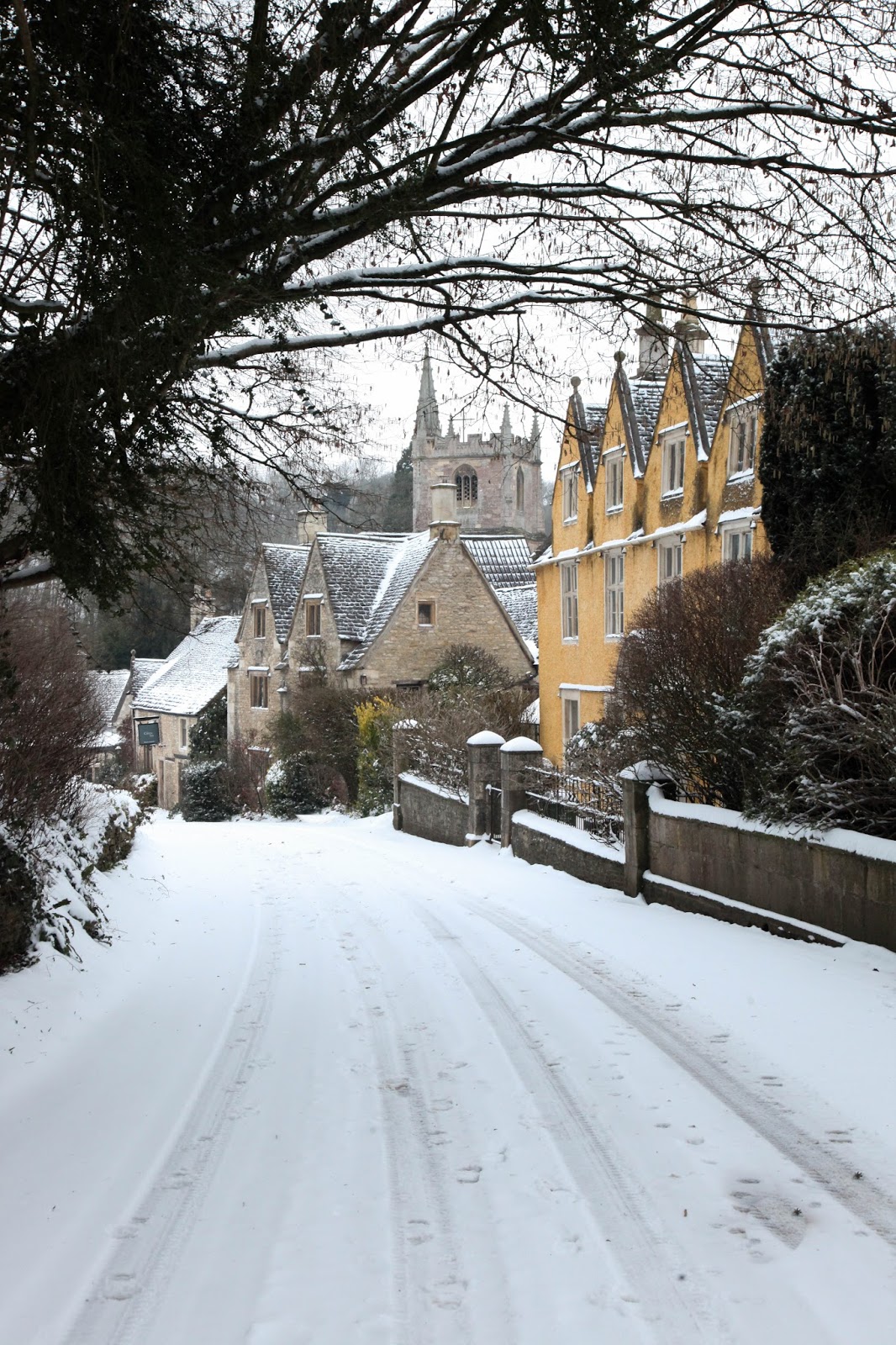
The beast from the east

On Thursday of last week it began to snow. It was bitterly cold (the air temperature felt like -14 according to the weather report) and the snow kept falling. By Thursday night the roads were becoming icy and dangerous. And still the snow kept coming, blown in by a freezing and relentless wind from the east. The fountain outside the manor house froze, and ice clumps began to form on the branches of willow trees as they trailed in the swirling sub-zero water of the brook.


Heaven knows what happened in the darkness of Thursday night, because by Friday morning England was buried in snow drifts and the whole country stopped. 

We have two ways in and out of our village, one was utterly impassable, the snow had gathered between the hedges and buried the lane in snow drifts. The other steep road out was blanketed in snow and ice that only 4x4 cars could manage to get up. And so, we were snowed in for over 24 hours. Snowed in, but happy.


It was magical, even if we were trapped for a period of time, but now our thoughts are firmly on springtime warmth and the coming blossom.

Kate  x


{Images are mine, please do not share without permission}.